Updated September 2026 by Dawit Deggu Mohis, Addis Ababa.

Irreecha 2026 falls on Saturday 3 and Sunday 4 October — Meskerem 23 and 24 in the Ethiopian calendar. Hora Finfinne in Addis Ababa is marked on the Saturday, and Hora Arsadi in Bishoftu, the largest and best-known gathering, on the Sunday.

If you are in Ethiopia this week, this is the single biggest cultural event you could see.

What Irreecha is
Irreecha is the thanksgiving festival of the Oromo people, the largest ethnic group in Ethiopia. It marks the end of the long rains — Ganna — and the beginning of Birraa, the bright season, when the rivers fall, the roads dry out and the countryside turns yellow with adey abeba flowers.

The meaning is gratitude. People give thanks to Waaqa — God in the Oromo tradition — for surviving the dark, difficult rainy months and for the harvest to come. Families who have been separated by the rains meet again. Disputes are settled. Blessings are asked for the year ahead.

It is one of the oldest continuously observed festivals in the Horn of Africa, rooted in the Oromo indigenous belief system, and today it is attended by Oromos of every faith — followers of Waaqeffannaa, Orthodox Christians, Protestants and Muslims alike. That is part of what makes it remarkable: it is a cultural gathering more than a religious service.

A common claim online is that Irreecha is inscribed on UNESCO's Intangible Cultural Heritage list. That is not quite right, and it is worth stating correctly: what UNESCO inscribed, in 2016, is the Gadaa system — the Oromo indigenous system of governance of which Irreecha is part. Irreecha itself has been proposed for inscription in its own right but has not yet been listed.

What actually happens
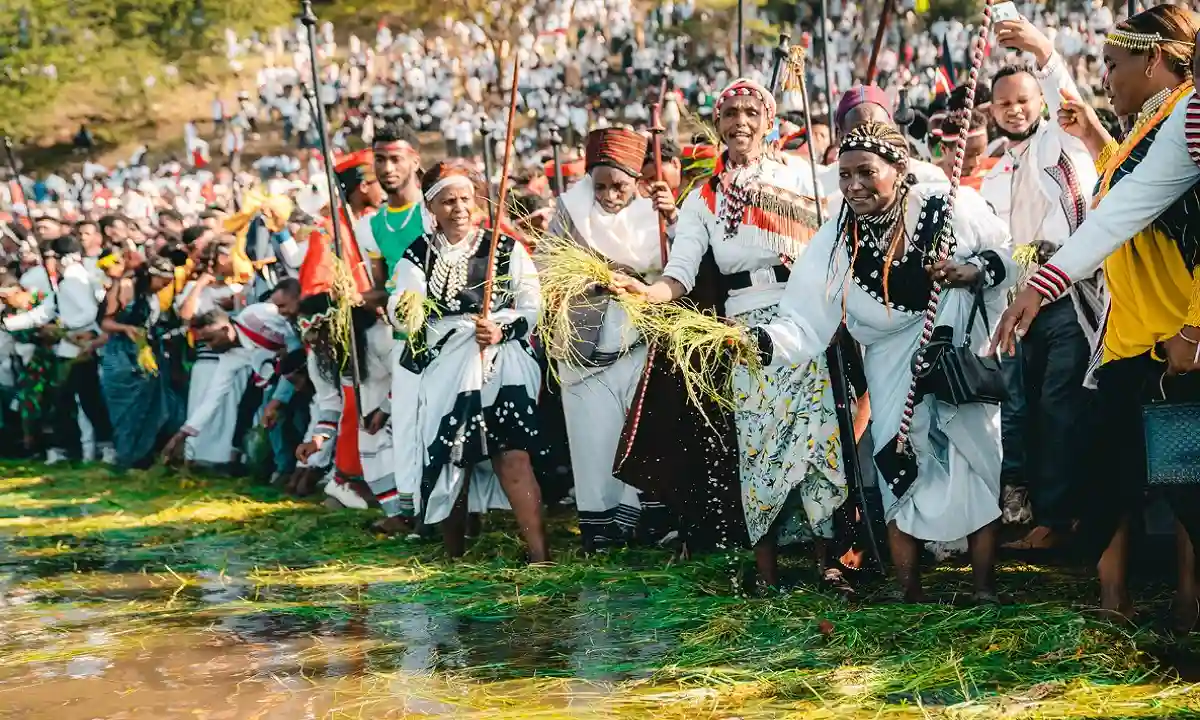
The ceremony takes place at water — a lake, a river or a spring. Water is where thanks are given, because water is what the rains brought.

Participants dress in white traditional clothing with bright borders, carrying freshly cut green grass and yellow flowers. They dip the grass and flowers into the water and sprinkle it over their heads and one another, praying and giving thanks. Elders — the Abbaa Gadaa, the leaders of the Gadaa system of governance — lead the blessings.

Around the ritual there is singing, chanting, drumming and dancing, and an enormous, joyful crowd. At Bishoftu the numbers run into the millions.

The Gadaa system that shapes the ceremony is an indigenous democratic structure in which leadership passes peacefully in eight-year cycles, and it was inscribed by UNESCO as Intangible Cultural Heritage in 2016. Watching the elders at Irreecha is watching a living political tradition, not a performance.

Where it is held
Hora Arsadi, Bishoftu — the main and most famous celebration, at the crater lake in Bishoftu (Debre Zeyit), about 45 km southeast of Addis Ababa. This is the one people travel for. More about the town and its lakes on our Bishoftu page.

Hora Finfinne, Addis Ababa — a major gathering in the capital.

Irreecha Malkaa and Irreecha Tulluu — the lakeside celebration in spring and a second celebration on hilltops later in the year. The October event is Irreecha Malkaa.

Local Irreecha ceremonies are also held at water across Oromia, and by Oromo communities abroad — in Minnesota, Washington DC, Melbourne and elsewhere.

Going as a visitor
Irreecha welcomes visitors, and foreign guests are generally received warmly. A few things will make the day better for you and more respectful to the people around you.

Go early. Very early. The roads to Bishoftu fill, and the lakeside area is full long before the ceremony peaks.

Getting there. Bishoftu is an hour from Addis in normal traffic and considerably more on Irreecha day. Going with a local — a driver, a guide, an Oromo friend — is worth far more than the cost. Public transport runs but will be packed.

Dress. White clothing is traditional and you will not look out of place in plain, modest clothes. Avoid anything revealing.

Photography. Ask before photographing individuals, especially elders in ceremonial dress. The general scene is fine; a face is a person.

This is a religious ceremony, not a show. Stand back during the blessings. Do not walk between the elders and the water. Follow what the people around you do.

Crowds. The gathering is genuinely enormous. Keep your valuables in a zipped inner pocket, agree a meeting point with anyone you are with, carry water, and be prepared for it to take a long time to get out afterwards. General advice on safety in Ethiopia.

A note on the politics. Irreecha has at times been a place where political tension has surfaced, and the 2016 gathering ended in a disaster in which many people died. Recent years have passed peacefully with heavy organisation and security. Check the current situation and local advice before you go, and if you are attending, stay with a local who can read the mood. [VERIFY: the current security arrangements and any official guidance for this year.]

Some words you will hear
Oromo	Meaning
Irreecha	The thanksgiving ceremony itself
Waaqa	God
Hora	Lake
Malkaa	River crossing or water bank
Birraa	The bright season after the rains
Gadaa	The Oromo system of governance by age-sets
Abbaa Gadaa	The elder leading the Gadaa
Baga geessan	"Congratulations on arriving" — the greeting of the day
If you missed it this year
Irreecha falls at the end of September or the start of October each year, a little over two weeks after the Ethiopian New Year. It is one of three great festivals worth planning a trip around, alongside Meskel in late September and Timkat in January. Details on the best time to visit Ethiopia.

Frequently asked questions
When is Irreecha 2026?

Saturday 3 October at Hora Finfinne in Addis Ababa and Sunday 4 October at Hora Arsadi in Bishoftu — Meskerem 23 and 24 in the Ethiopian calendar.

What does Irreecha celebrate?

Thanksgiving to Waaqa for the end of the rainy season and the arrival of Birraa, the bright season — and the reuniting of families separated by the rains.

Where is the main Irreecha celebration?

At Hora Arsadi, the crater lake in Bishoftu, about 45 km from Addis Ababa. It is the largest gathering, attended by millions.

Can tourists attend Irreecha?

Yes, and visitors are welcomed. Dress modestly, ask before photographing people, go very early, and treat it as a ceremony rather than a spectacle.

Is Irreecha a religious or cultural festival?

Both. It comes from the Oromo indigenous faith, Waaqeffannaa, and is today attended by Oromos of all religions as a cultural gathering.

Is Irreecha a public holiday in Ethiopia?

It is observed as a holiday in the Oromia region, and the Bishoftu gathering draws people from across the country.

About the author — Dawit Deggu Mohis

Dawit Deggu Mohis is an Ethiopian travel enthusiast who has spent years exploring and learning about his country's rich history, diverse cultures, and stunning landscapes. Through his writing he shares practical tips, cultural insights, and personal discoveries to help travellers experience Ethiopia more deeply and respectfully. Found something on this page that has changed? Tell him and it will be fixed.