Updated September 2026 by Dawit Deggu Mohis, Addis Ababa.
Coffee was not invented in Ethiopia; it simply grew here, and still does, wild in the forests of Kaffa in the south-west — the region that gave the plant, and eventually half the world’s languages, the word coffee. What Ethiopia did invent is the way it is drunk.
The buna ceremony is performed in homes across the country every day, often more than once. It is not a restaurant show. It takes over an hour, it is done by hand from green beans, and it is the social centre of Ethiopian life — where news is exchanged, disputes are settled and guests are honoured.
The equipment
| Amharic | What it is |
|---|---|
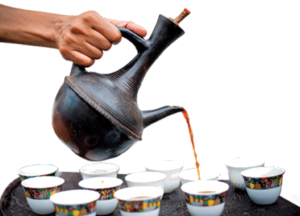
| Jebena (ጀበና) | The black clay pot with a round belly, long neck and straw lid that the coffee is brewed in |
| Sini | The small handleless cups, served on a tray |
| Rekbot | The low wooden stand the cups sit on |
| Menkeshkesha | The metal pan for roasting the beans over coals |
| Mukecha and zenezena | The heavy wooden mortar and pestle for grinding |
| Etan | Frankincense, burned throughout |
The jebena is unglazed clay, and an old one that has brewed thousands of pots is valued over a new one.
Step by step
1. The ground is prepared
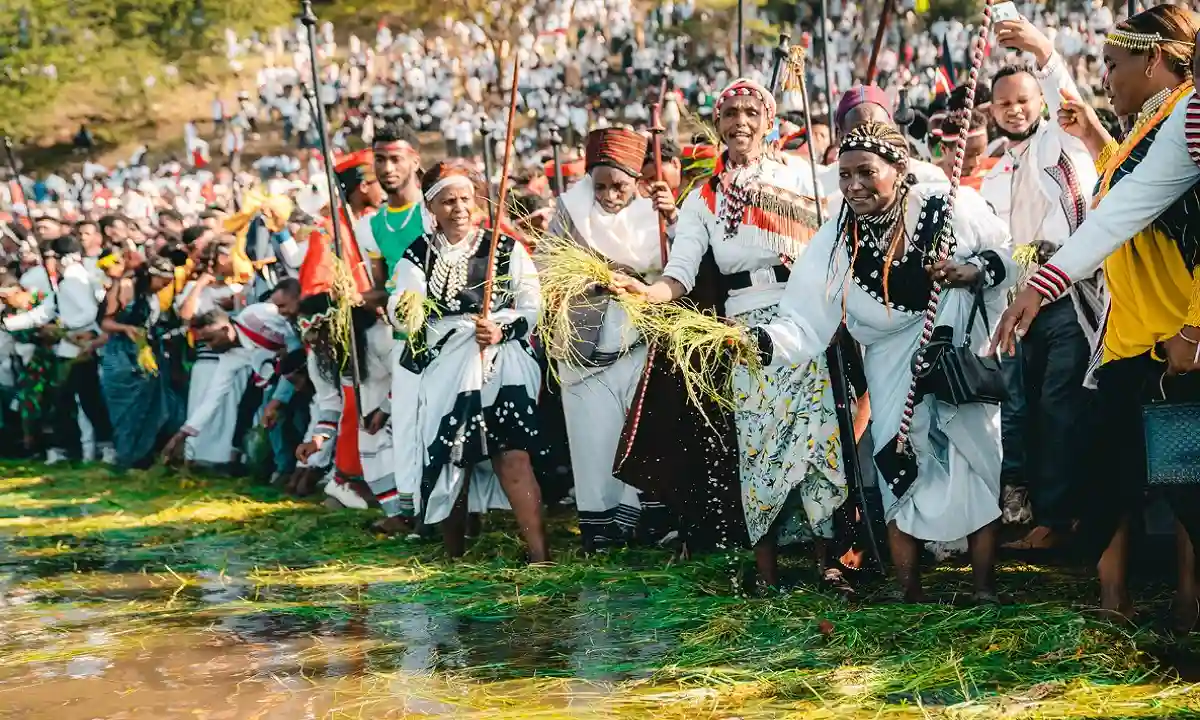
Fresh grass and rushes — ketema — are scattered on the floor where the ceremony will happen, sometimes with flower petals through it. It brings the outside in, and it smells of cut grass for the next hour.
The woman performing the ceremony sits on a low stool behind the equipment. Traditionally this is the youngest woman of the household or the hostess, dressed in the white habesha kemis with woven borders.
2. Incense is lit
Frankincense goes onto the coals and smoke fills the room. Ethiopia and neighbouring Somalia have traded frankincense for millennia; the smell is inseparable from both church and home here. It burns through the whole ceremony.
3. The beans are washed and roasted
Green beans are rinsed in water in the pan, then roasted over charcoal, shaken constantly, until they darken and begin to crackle and release oil. This takes fifteen to twenty minutes and fills the room with smoke.
Then comes the part visitors always remember: the hostess carries the smoking pan around the room and holds it in front of each guest, who wafts the smoke towards their face with a hand and breathes it in. You say “betam tiru” — very good. This is not optional politeness; it is a greeting made of smoke.
4. Grinding
The roasted beans go into the wooden mortar and are pounded by hand with a long pestle. The rhythm of the pounding is part of the sound of an Ethiopian morning.
5. Brewing
The grounds go into the jebena with water, and it sits on the coals until it rises. Skilled hosts catch it exactly as it climbs the neck. It may be brought to the boil more than once, and is sometimes strained through horsehair or a filter in the spout.
6. Pouring
This is the moment of theatre. The jebena is lifted high and the coffee is poured from a height of a foot or more, in one continuous motion, moving along the row of cups without stopping and without spilling — the height settles the grounds and aerates the coffee.
The cups are filled to the brim. Sugar is added generously; in parts of the country, salt or butter instead, and in the south you may be offered it with tena adam (rue), a herb laid in the cup that gives it a sharp, medicinal edge worth trying at least once.
7. Three rounds, in this order
The ceremony is three servings, and this is the part that catches visitors out:
| Round | Name | Meaning |
|---|---|---|
| First | Abol | The strongest |
| Second | Tona | Weaker, from a second brew of the same grounds |
| Third | Baraka | Weakest — and the one that carries the blessing |
Baraka means blessing. The third cup is understood to confer it, and leaving before it is drunk is a real discourtesy. Budget an hour to ninety minutes from the first roast to the last cup.
Snacks are served alongside: kolo (roasted barley), popcorn — which turns up at every ceremony and nobody can explain why — and sometimes himbasha bread or peanuts.
What it is actually for
An Ethiopian household may hold a ceremony in the morning, at midday and in the evening. Neighbours drift in. It is how a street stays a street.
It is also where things get resolved. Elders mediating a dispute do it over buna. A marriage proposal is discussed over buna. Condolences are paid over buna, and after a funeral the ceremony runs for days in the mourning house. When Ethiopians say “buna tetu” — come and drink coffee — the coffee is the smallest part of the invitation.
Refusing it is close to refusing the household itself. If you cannot drink coffee, accept the cup, hold it, and sip once; nobody is counting. The wider etiquette of visiting an Ethiopian home is on being a guest in an Ethiopian home.
Where a visitor can experience it
In someone’s home — by far the best version, and it happens more easily than you would expect. Say yes.
Traditional restaurants in Addis Ababa — most cultural restaurants perform a ceremony in the evening alongside music and dancing. It is a shortened, staged version, but the coffee is real. See things to do in Addis Ababa.
Hotels — the larger hotels run a ceremony in the lobby in the afternoon, usually free for guests.
Coffee farms and washing stations in Yirgacheffe, Sidama, Jimma, Harar and Kaffa — several now take visitors through the whole chain from tree to jebena. For anyone who cares about coffee, a trip to the Gedeo highlands is worth arranging.
Everywhere else — you will also find espresso machines in every Ethiopian town serving excellent macchiato for pennies, a legacy of the Italian occupation. That is a different pleasure, not a lesser one.
Regional differences worth knowing
- Harar brews it with cardamom and cinnamon, closer to the Arabian style across the water
- The south favours tena adam, the rue herb
- Afar and the Somali region often take it with salt, or brew the husks rather than the bean
- Kaffa, where the plant originates, has ceremonial forms tied to its own traditions
Where the coffee itself comes from
Ethiopia produces several of the most distinctive coffees in the world, and the names on a bag in a European café are places you can drive to:
Yirgacheffe — floral, citric, tea-like, from the Gedeo highlands. Sidamo — sweet, berry-like. Harar — dry-processed, blueberry and wine. Jimma and Limu — earthy and full-bodied. Guji — increasingly the one specialty buyers chase.
Most of it is grown by smallholders on garden plots of a few trees, not on plantations — which is why Ethiopian coffee retains so many distinct local varieties. Coffee remains the country’s largest export.
Frequently asked questions
How long does an Ethiopian coffee ceremony take?
Usually an hour to ninety minutes, covering three rounds of coffee from beans roasted at the start.
What are the three rounds called?
Abol, tona and baraka. The third, baraka, means blessing and is the one you should stay for.
What is a jebena?
The round-bellied black clay pot with a long neck used to brew the coffee over coals.
Is coffee from Ethiopia?
Yes. Coffea arabica originates in the forests of south-west Ethiopia and still grows wild there. The word coffee is generally traced to the region of Kaffa.
Can I refuse coffee in Ethiopia?
You can, but it lands badly. Accept the cup and sip once if you do not want to drink it.
Why is popcorn served with coffee?
It simply is, at nearly every ceremony, along with roasted barley. Nobody offers a satisfying explanation, and every household does it.
Can I buy a jebena to take home?
Yes — Merkato and Shiro Meda in Addis sell them cheaply. Wrap it very well; it is unglazed clay and breaks easily.
About the author — Dawit Deggu Mohis
Dawit Deggu Mohis is an Ethiopian travel enthusiast who has spent years exploring and learning about his country’s rich history, diverse cultures, and stunning landscapes. Through his writing he shares practical tips, cultural insights, and personal discoveries to help travellers experience Ethiopia more deeply and respectfully. Found something on this page that has changed? Tell him and it will be fixed.