Updated September 2026 by Dawit Deggu Mohis, Addis Ababa.
Meskel is celebrated every year on 27 September — 28 September in the year before an Ethiopian leap year — and it is the most visually spectacular night in the Ethiopian calendar. A pyre the height of a building is lit at the centre of Addis Ababa while tens of thousands of people sing around it in white.
Meskel means cross in Ge’ez. The festival commemorates the finding of the True Cross, and it is inscribed on UNESCO’s list of Intangible Cultural Heritage.
The story behind it
In the fourth century, Empress Helena — mother of the Roman Emperor Constantine — set out to find the cross on which Christ was crucified. Unable to locate it, she was told in a vision to light a bonfire and follow the smoke. She lit the fire, the smoke bent towards the ground, and the cross was found beneath.
That is why Meskel is a festival of fire and smoke. The bonfire is not decoration; it is the re-enactment of the search.
Ethiopian tradition holds that a fragment of the True Cross was brought to Ethiopia and is kept at Gishen Mariam monastery in Wollo, which is itself a place of pilgrimage around this time of year.
What happens on the night
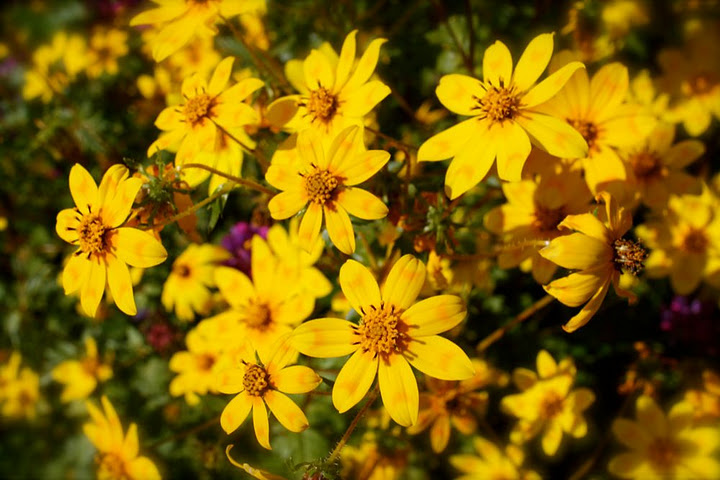
The Demera — the bonfire — is built as a tall conical pyre of wooden poles bound together, topped with a cross and decorated with adey abeba, the yellow daisies that cover Ethiopia at the end of the rains.
On the eve of Meskel, 26 September, the ceremony begins in the late afternoon:
- The procession. Priests of the Ethiopian Orthodox Tewahedo Church arrive in embroidered ceremonial robes and velvet umbrellas, carrying crosses, drums and sistra. Church choirs and debtera chant.
- The circling. The clergy circle the Demera, singing, while the crowd holds thin yellow candles — also called demera — in their hands.
- The lighting. At dusk the pyre is lit. It burns enormously, and the crowd sings as it catches.
- The fall. The direction in which the burning cross falls is read as a sign for the year ahead — a good harvest, or trouble.
- The ash. People mark their foreheads with a cross in the ash the next morning. Some take embers home to light their family’s smaller bonfire.
The following day, 27 September, is the feast itself: church services in the morning, then family meals, doro wat, tej, and visiting.
Where to see it
Meskel Square, Addis Ababa — the national celebration, and the square is named for the festival. A semi-circular stepped viewing area holds tens of thousands. The scale is extraordinary and the atmosphere is festive rather than solemn. This is the one most visitors see.
Gondar — often described as the most beautiful setting for Meskel, with the celebration held in the grounds of the castles.
Axum and Lalibela — deeply traditional, with the ceremony rooted in the holiest church sites in the country.
Every neighbourhood. This is worth knowing: alongside the national Demera, families and neighbourhoods build their own small bonfires in the street and light them together. If you are staying in a residential area, you may see more of the real thing outside your door than at the square.
In the countryside, particularly among the Gurage and in the south, Meskel is the year’s biggest family festival — bigger than Christmas — with relatives travelling home and animals slaughtered for the feast.
Going as a visitor
Arrive early at Meskel Square, several hours before dusk, or you will be far from the pyre. The lighting is at sunset, around 6pm.
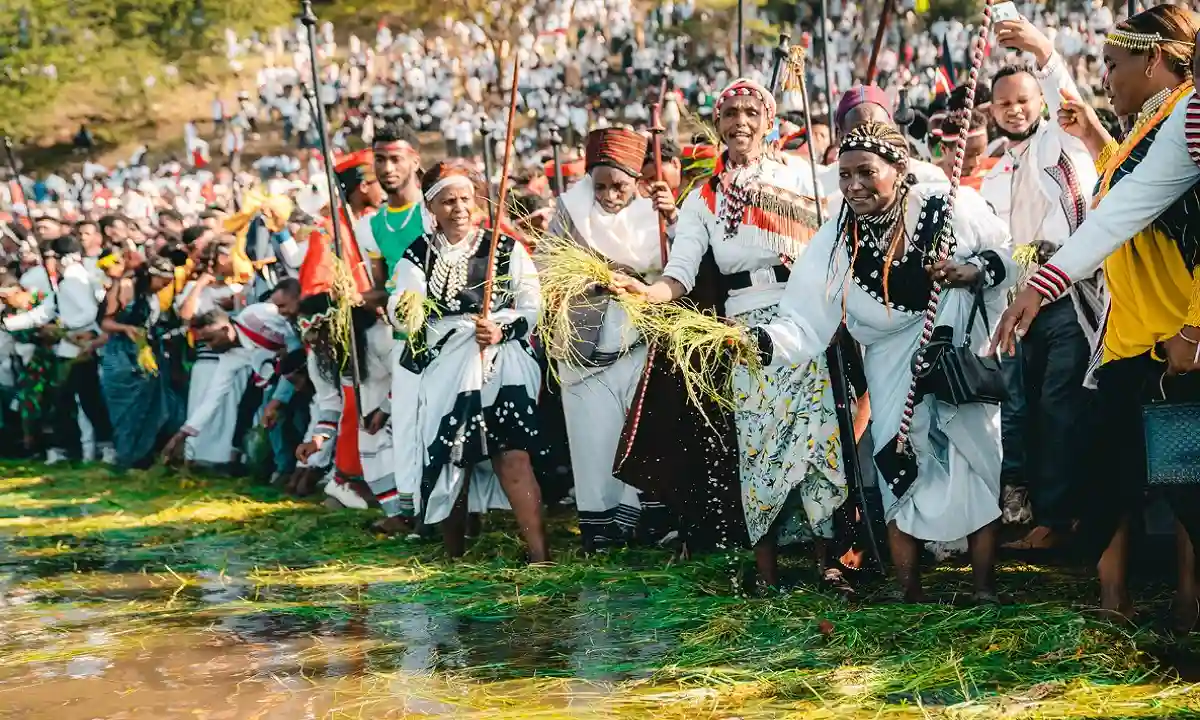
Dress: modest clothing, and white if you have it. Ethiopians wear the white netela and gabi, and you will see a sea of it.
Bring: a candle (sold everywhere on the day), a light jacket — late September evenings in Addis are cool — and a camera that handles low light, because the best moments are after dark.
Be careful near the fire. The crowd surges when the pyre is lit and sparks travel. Stand back, especially with children.
Photography of the ceremony and the crowd is entirely normal. As always, ask before pointing a camera at an individual’s face, and be respectful around clergy.
Book accommodation early if you are travelling to Gondar, Lalibela or Axum for Meskel. Hotels in those towns fill weeks ahead, and check your government’s current travel advice for the north before you plan the trip.
Meskel and the Ethiopian year
Meskel comes at a particular moment: two weeks after Enkutatash, the Ethiopian New Year on 11 September, and just before Irreecha, the Oromo thanksgiving in early October. All three mark the same turning point — the end of the long rains and the start of the bright season.
That makes mid-September to mid-October the richest few weeks in the Ethiopian calendar, and an outstanding time to visit: the countryside is green, the yellow adey abeba is everywhere, and there are three major festivals within a month. See the best time to visit Ethiopia.
If the dates confuse you, they will — the Ethiopian calendar has 13 months and runs seven to eight years behind the Gregorian one. It is explained on the Ethiopian calendar page.
Frequently asked questions
When is Meskel celebrated?
27 September each year, or 28 September in the year preceding an Ethiopian leap year. The Demera bonfire is lit on the eve, 26 September.
What does Meskel mean?
“Cross” in Ge’ez. The festival commemorates Empress Helena’s finding of the True Cross in the fourth century.
What is the Demera?
The tall conical bonfire built for the festival, topped with a cross and yellow flowers, lit at dusk on the eve of Meskel.
Where is the best place to see Meskel?
Meskel Square in Addis Ababa for the scale, Gondar for the setting, and your own neighbourhood for the most personal version.
Can tourists attend Meskel?
Yes. It is a public celebration and visitors are welcome. Dress modestly, arrive early and stand back from the fire.
Is Meskel a public holiday in Ethiopia?
Yes, it is a national public holiday.
Is Meskel the same as Irreecha?
No. Meskel is an Ethiopian Orthodox Christian festival on 27 September; Irreecha is the Oromo thanksgiving held at water in early October. They fall close together because both mark the end of the rainy season.
About the author — Dawit Deggu Mohis
Dawit Deggu Mohis is an Ethiopian travel enthusiast who has spent years exploring and learning about his country’s rich history, diverse cultures, and stunning landscapes. Through his writing he shares practical tips, cultural insights, and personal discoveries to help travellers experience Ethiopia more deeply and respectfully. Found something on this page that has changed? Tell him and it will be fixed.