Many of Ethiopia’s best-known wild animals live nowhere else. They include a red wolf that hunts rodents on plateaus at 4,000 metres, a grass-eating monkey and a wild goat adapted to steep highland cliffs. Most live in cool grassland and forest above the surrounding lowlands.
What makes Ethiopia’s wildlife unique?
An animal is endemic when it occurs naturally in one place and nowhere else. The term does not mean rare or endangered. The gelada is endemic to Ethiopia and still fairly common, while the lion is rare in Ethiopia but lives in many countries.
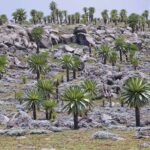
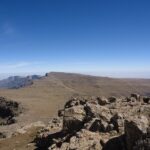
Ethiopia’s mountains help explain this concentration of endemic species. About four-fifths of the land above 3,000 metres in tropical Africa lies in Ethiopia. As the climate warmed and cooled over hundreds of thousands of years, animals adapted to the cold highlands became isolated from relatives elsewhere and gradually developed into new species. The highest zone, known as Afroalpine habitat, supports tussock grass, giant lobelias and heather a few hundred kilometres from the equator.
For Ethiopia’s plants and landscapes, see wildlife and vegetation.
The Ethiopian wolf
How to recognise it
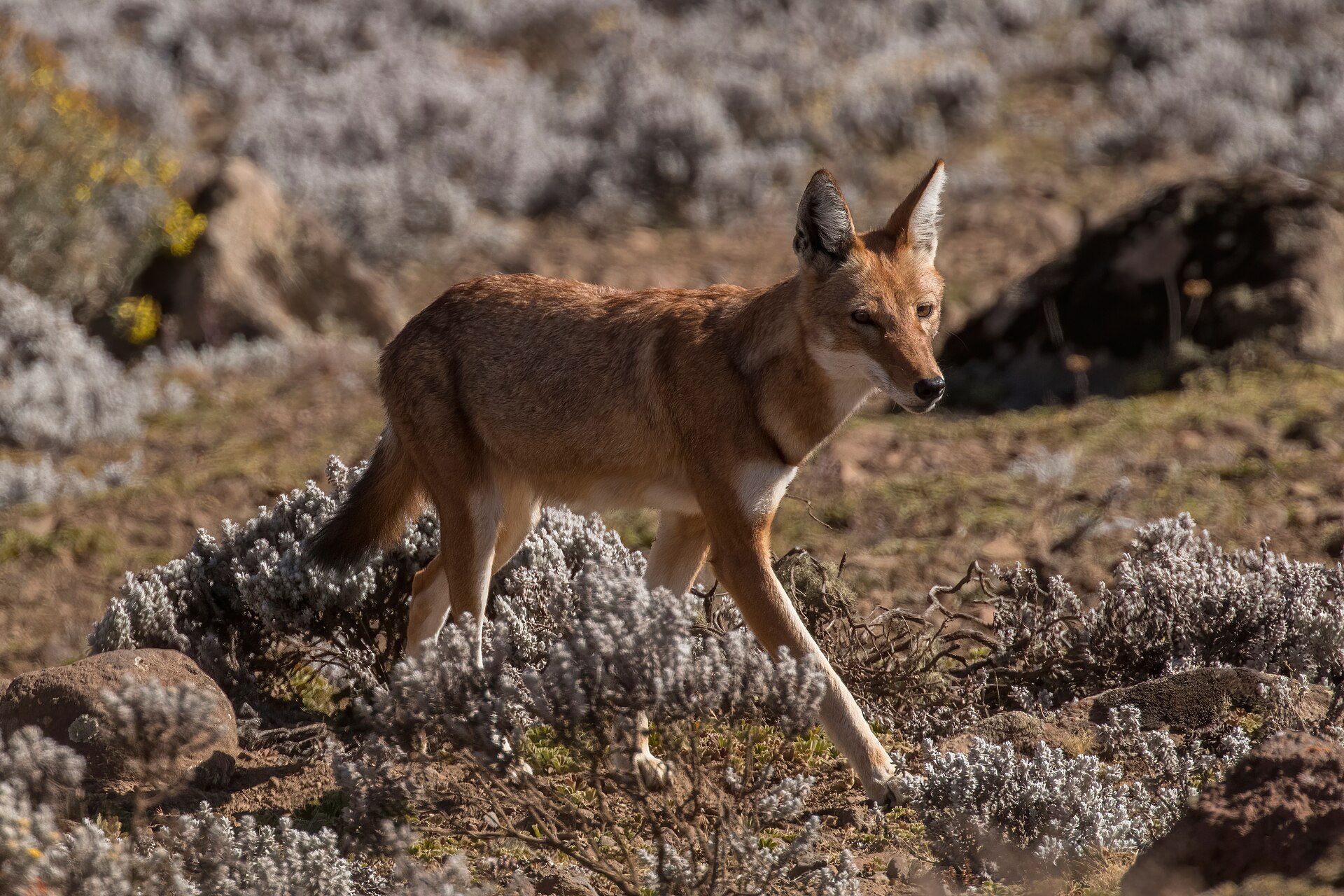
The Ethiopian wolf (Canis simensis) has long legs, a rusty red coat, a white throat and chest, a narrow muzzle and a bushy tail with a dark tip. It stands about 60 centimetres at the shoulder and weighs 11 to 19 kilograms, with males larger than females. Older books call it the Simien fox or Abyssinian jackal. DNA places it with true wolves, closer to the grey wolf than to any jackal.
Where it lives
Ethiopian wolves live in Afroalpine grassland, usually above 3,000 metres. Fewer than 500 adults remain across about half a dozen isolated mountain ranges. More than half live in the Bale Mountains, especially on the Sanetti Plateau. Smaller groups occur in the Simien Mountains, Guassa, the Arsi Mountains and several other highlands. It is one of the world’s rarest wild dogs and Africa’s most threatened carnivore.
What it eats
Rodents make up almost all of the wolf’s diet. Packs share and defend a territory, although individual wolves usually hunt alone. They walk slowly across the grass, stop, then pounce on a rat at its burrow. In Bale, the giant mole-rat is their preferred prey. A 2024 study in the journal Ecology reported Ethiopian wolves licking nectar from red hot poker flowers in Bale and getting pollen on their muzzles. The authors suggest the wolves may help pollinate the plant, which would be unusual for a large carnivore.
Why it is endangered
The IUCN lists the wolf as Endangered. Farming and grazing continue to move higher into its small, fragmented habitat. Disease is another major threat. Rabies and canine distemper caught from village dogs have killed large parts of the Bale population during several outbreaks. Since the 1990s, the Ethiopian Wolf Conservation Programme has monitored packs, vaccinated village dogs and vaccinated wolves against rabies.
The gelada
The “bleeding-heart monkey”
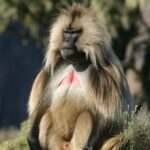
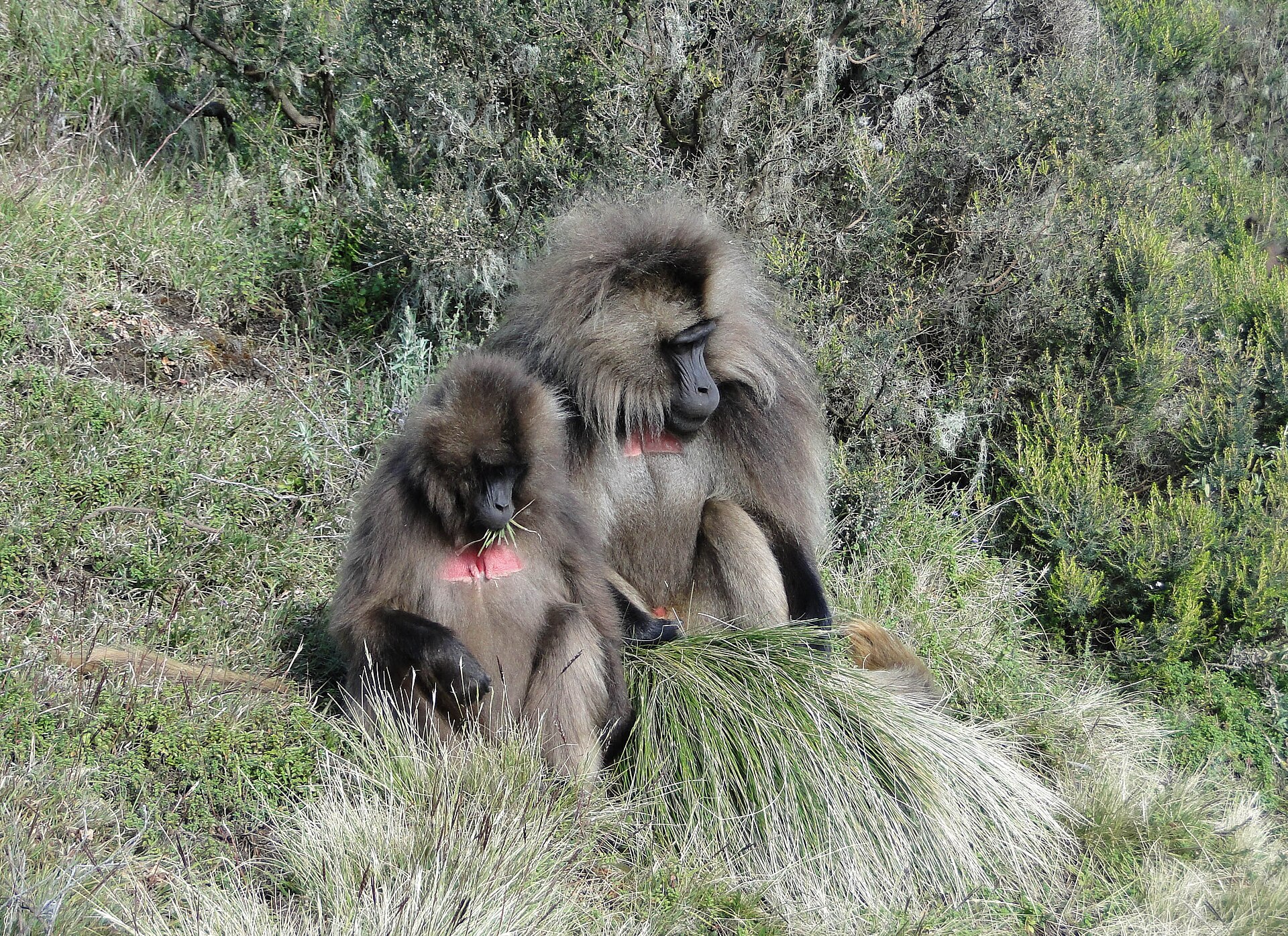
The gelada (Theropithecus gelada) is a large monkey with long brown fur, a pale face and an hourglass-shaped patch of bare red skin on its chest. The patch is the source of its nickname, “bleeding-heart monkey”. Adult males have a heavy cape of hair over their shoulders. Despite the common name gelada baboon, geladas are not true baboons. They are the last surviving species of a group whose fossils have been found across Africa and as far away as Spain and India.
What it eats
Geladas are the only primates whose diet comes mainly from grazing. They spend much of the day sitting on the ground and plucking grass blades and seeds with nimble fingers. They move between patches by shuffling forward without standing. During the dry season, they dig for roots and bulbs.
Where it lives
Geladas live between about 1,800 and 4,400 metres in the northern and central highlands, close to steep cliffs. At night they climb down to narrow ledges beyond the reach of leopards and hyenas. Feeding groups can often be seen from a few metres away in the Simien Mountains and Guassa.
Family life
A gelada family usually consists of one leading male, several females and their young, sometimes joined by a younger “follower” male. Families form bands, and bands gather into herds numbering many hundreds. Geladas have one of the richest vocal repertoires among monkeys. Researchers have compared the rising and falling rhythms of some calls to human speech.
Are geladas endangered?
The IUCN lists geladas as Least Concern, and large populations remain. Farms are replacing some of their grassland, and crop raids create conflict with farmers in certain areas.
The walia ibex
What it is
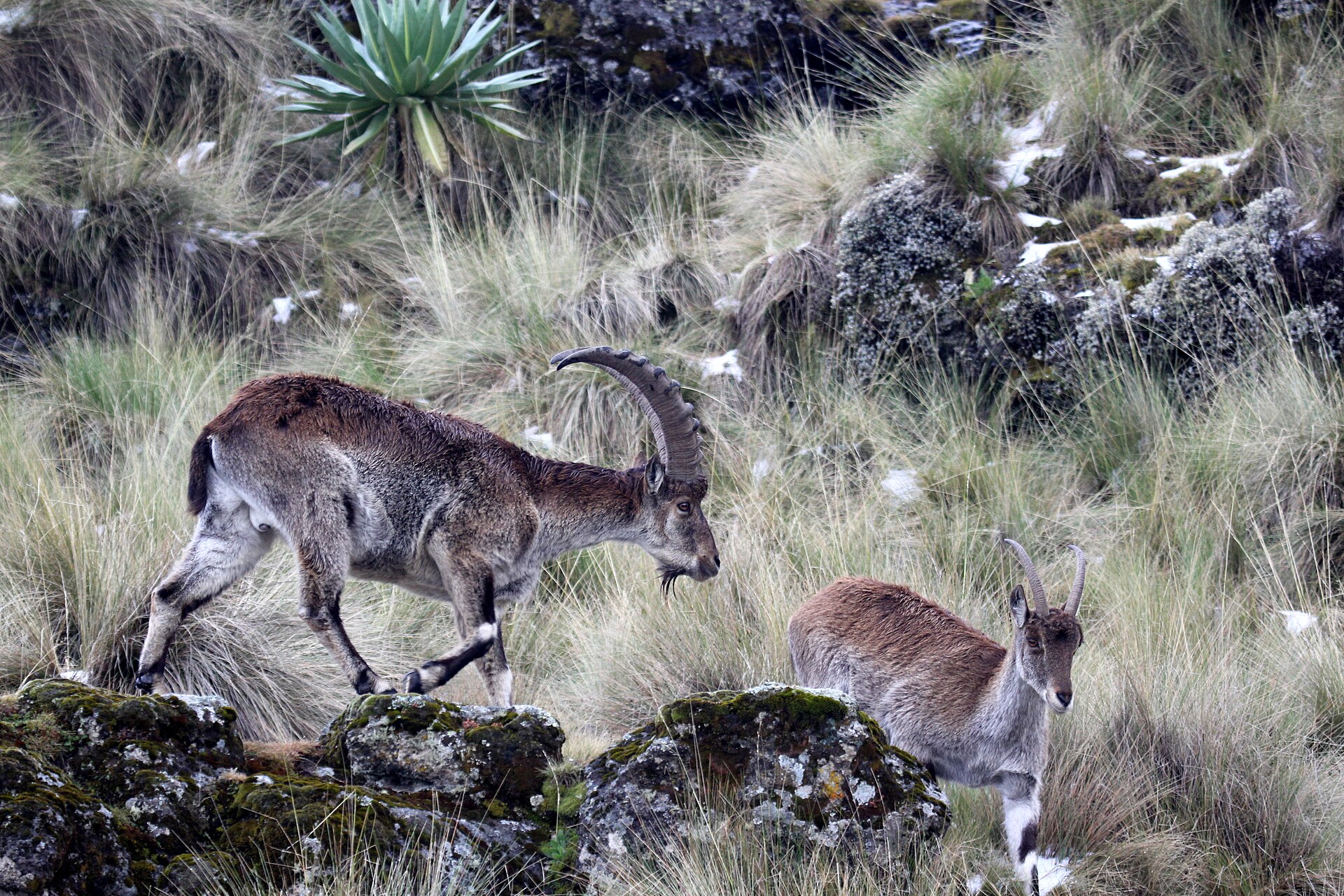
The walia ibex (Capra walie) is a wild goat with a brown coat and pale belly. Males have a dark beard and horns up to about a metre long that curve back over the body. The species is a close relative of the Nubian ibex of Sudan and Arabia, from which it separated long ago.
Where it lives
The entire wild population lives in the Simien Mountains, along the northern escarpment where the land drops more than a thousand metres in places. Walia move across narrow ledges and graze near the cliff edge in the early morning and evening.
What it eats
Grasses, herbs, shrubs, lichens and the leaves of the giant heather and other trees that grow on the cliffs. Males are often seen standing on their hind legs to reach branches.
Why it is threatened
Walia have always been few, and hunting and grazing brought them close to extinction. Only a few hundred remained by the 1990s, one reason UNESCO placed Simien Mountains National Park on the World Heritage in Danger list in 1996. Numbers recovered under stricter protection, reaching about 865 in 2015, and UNESCO removed the park from the danger list in 2017.
The recovery has since reversed. Counts fell to about 300 in 2024 and 271 in December 2025, and in 2026 the IUCN again listed the walia ibex as Critically Endangered. Poaching is named as the main cause, followed by pressure on its habitat and a period of reduced patrols and tourism income during the COVID-19 pandemic.
The mountain nyala
How to recognise it
The mountain nyala (Tragelaphus buxtoni) is a large antelope with a greyish-brown coat, faint white stripes and spots, and a white chevron between the eyes. Males weigh up to 300 kilograms and have long horns with one or two open twists. Its relatives include the kudu and bushbuck.
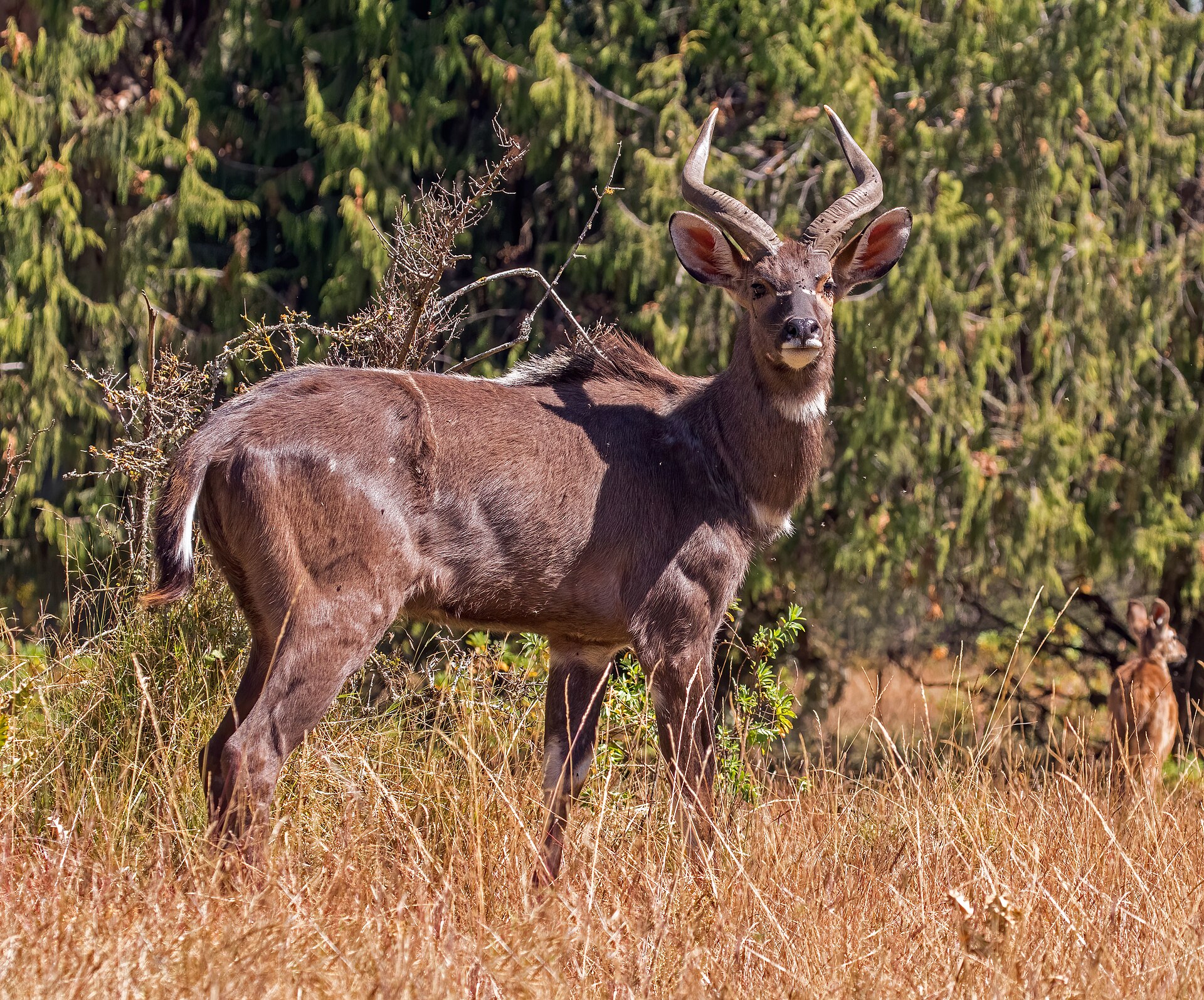
It was among the last large African mammals documented by Western science. The first specimen was collected in 1908 and described in 1910.
Where it lives
Mountain nyala live between about 3,000 and 4,000 metres in the southern highlands east of the Rift Valley, including the Bale Mountains, Arsi Mountains and nearby ranges. They are most easily seen in the grasslands around the Bale park headquarters at Dinsho and in the Gaysay valley.
What it eats
Its diet consists mainly of leaves, shoots, herbs and lichens, making it more of a browser than a grazer. It eats more young grass during the wet season.
Conservation
The mountain nyala is listed as Endangered. Its population has fallen as forest and grassland have become farmland, and cattle compete with it for grazing. Hunting is now banned or tightly controlled.
Other endemic mammals
Bale monkey
The Bale monkey (Chlorocebus djamdjamensis) is a small grey-green relative of the vervet with a thick coat suited to cold conditions. It lives in southern highland bamboo forests, mainly Bale’s Harenna Forest and Odobullu Forest, and feeds mostly on young bamboo leaves and shoots. Forest clearing is a serious threat because the monkey depends heavily on bamboo. It is listed as Vulnerable.
Giant mole-rat
The giant mole-rat (Tachyoryctes macrocephalus) is a large-headed rodent weighing up to about a kilogram. It lives in the high grasslands of the Bale Mountains, where it digs tunnels and emerges to take plants near its burrow. It is the Ethiopian wolf’s main prey in Bale, and its digging changes the Afroalpine meadow.
Menelik’s bushbuck
A very dark, nearly black form of bushbuck lives in the forests of the central and southern highlands. Most scientists classify it as an Ethiopian subspecies rather than a separate species. Its appearance differs sharply from the reddish bushbuck of the lowlands.
Swayne’s hartebeest
Swayne’s hartebeest is a chocolate-brown subspecies of hartebeest. It once also lived in Somalia but is now found only in Ethiopia, at Senkele Swayne’s Hartebeest Sanctuary in the Rift Valley and Maze National Park.
Endemic birds
Ethiopia has more than 800 bird species. About 20 occur nowhere else, according to Wikipedia’s national bird list, and others are found only in Ethiopia and neighbouring Eritrea. Counts differ between checklists, so treat the number as approximate.
| Bird | Where to look | Notes |
|---|---|---|
| Ethiopian bush-crow | Around Yabello and Mega, in the south | A pale grey crow-like bird with a blue eye patch. It lives only in a small area of southern savanna. |
| White-tailed swallow | Same area as the bush-crow | A small swallow with a white tail. |
| Spot-breasted lapwing | High grassland, such as Bale and Sululta | A wader with a spotted breast. |
| Blue-winged goose | Highland marshes and lakes | A grey-brown goose with pale blue wing patches, seen in flight. |
| Prince Ruspoli’s turaco | Juniper forest in the south, including Harenna Forest | A bright green turaco with a white crest. |
| Wattled ibis | Common across the highlands, even in Addis Ababa | Easy to spot by its loud calls. Found only in Ethiopia and Eritrea. |
| Thick-billed raven | Highlands | One of the world’s largest crows. Found only in Ethiopia and Eritrea. |
Where to see Ethiopia’s endemic wildlife
Simien Mountains National Park
The Simien Mountains are the main place to see geladas and the only home of the walia ibex. Ethiopian wolves also live on higher ground, although they are harder to find here than in Bale. See the Simien Mountains guide.
Bale Mountains National Park
The Sanetti Plateau, crossed by a road at about 4,000 metres, offers the best chance to see Ethiopian wolves. Bale also supports mountain nyala, Menelik’s bushbuck, giant mole-rats, Bale monkeys in Harenna Forest and many endemic birds. See the Bale Mountains guide.
Guassa Community Conservation Area
Guassa is a high plateau in the Menz highlands north-east of Addis Ababa, with geladas and Ethiopian wolves. For centuries, local communities have managed its grass through a traditional system called qero, which controls when people may cut grass and graze cattle.
Yabello and the south
The dry acacia landscape around Yabello is the only place where both the Ethiopian bush-crow and white-tailed swallow can be seen.
Near Addis Ababa
Wattled ibises, thick-billed ravens and white-collared pigeons are common around the capital. The Entoto hills above the city and the Sululta plain to the north are accessible places for a morning of birdwatching.
Read your government’s current travel advice before visiting any of these areas. The national parks page lists the parks and the wildlife associated with each.
What threatens Ethiopia’s endemic animals?
Farms and villages are moving higher into the mountains, dividing habitat into smaller patches. Cattle, sheep and goats compete with wild grazers and wear down grassland. Domestic dogs pass rabies and distemper to Ethiopian wolves, while hunting and crop raiding create further conflict with people. Climate change also reduces the habitat available to Afroalpine animals already living near mountain summits.
How Ethiopia protects its wildlife
Most of these species live in national parks managed by the Ethiopian Wildlife Conservation Authority or in community-managed areas such as Guassa. The Ethiopian Wolf Conservation Programme has monitored wolves for decades, while other projects study geladas, walia and mountain nyala. Park fees and work for local guides, scouts and horse handlers give nearby communities an economic interest in conservation.
Visitors can support this work by hiring local guides and scouts, keeping their distance from animals, avoiding feeding wildlife and leaving dogs outside the parks.
At a glance
| Animal | Scientific name | Main habitat | Main food | IUCN status* |
|---|---|---|---|---|
| Ethiopian wolf | Canis simensis | Afroalpine grassland | Rodents | Endangered |
| Gelada | Theropithecus gelada | Highland grassland near cliffs | Grass | Least Concern |
| Walia ibex | Capra walie | Simien cliffs | Shrubs, herbs, grass | Critically Endangered (2026) |
| Mountain nyala | Tragelaphus buxtoni | Highland forest and grassland | Leaves and herbs | Endangered |
| Bale monkey | Chlorocebus djamdjamensis | Bamboo forest | Bamboo | Vulnerable |
*IUCN Red List status in October 2026. Assessments change, so check iucnredlist.org for the latest.
Frequently asked questions
What animal is found only in Ethiopia?
The best known are the Ethiopian wolf, the gelada, the walia ibex and the mountain nyala. There are many smaller ones too, including rodents, frogs and about 20 kinds of bird.
What is the rarest animal in Ethiopia?
Among large mammals, the walia ibex and the Ethiopian wolf are the rarest, with roughly 270 walia and fewer than 500 wolves left. Some smaller species may be rarer or harder to find. The Nechisar nightjar, for example, is known from a single wing found in 1990.
Are Ethiopian wolves real wolves?
Yes. Genetic studies show they belong to the same group as the grey wolf, not to the jackals or foxes.
Are geladas baboons?
No, although they are often called gelada baboons. They belong to their own genus, Theropithecus.
Where can tourists see walia ibex?
Walia ibex live only in the Simien Mountains and are usually seen from the cliff-top trails between Chenek and Bwahit.
Which park has the most endemic wildlife?
The Bale Mountains have the largest population of Ethiopian wolves and more endemic mammals and birds than any other park.
How can visitors help?
Use local guides, keep your distance, do not feed wildlife, and support community conservation through park and guide fees.