Updated October 2026. Prices change often and are not listed here; agree fees with guides and hyena feeders before you start.
Harar is unlike anywhere else in Ethiopia. Behind its old stone wall lies a maze of narrow, whitewashed alleys, painted houses, mosques and shrines, where women in bright scarves sell coffee and spices and the call to prayer drifts over the rooftops. For centuries it was a walled Muslim city-state and a great trading centre between the highlands and the coast, and it is still the cultural home of the Harari people. At night, outside the walls, men feed wild hyenas by hand.
The walled city (Jugol)
The old town, called Jugol, is enclosed by a wall built in the 16th century under Emir Nur ibn Mujahid. Inside, an area of about one square kilometre holds dozens of mosques, including the Great Mosque (Jami), around a hundred shrines of local saints, and a dense web of alleys that is easy to get lost in, which is half the pleasure. Harar Jugol has been a UNESCO World Heritage Site since 2006, and many Muslims consider Harar one of the holy cities of Islam.
Things to look out for:
- The gates. The wall originally had five gates. A sixth, Harar Gate (Duke’s Gate), was added later and is now the busiest entrance, opening onto the main market streets.
- Traditional Harari houses. Inside, raised platforms, carved niches and walls hung with baskets and enamel plates make each one a small museum. Several are open to visitors.
- The Rimbaud House. A merchant’s house associated with the French poet Arthur Rimbaud, who lived and traded in Harar in the 1880s, now a museum with photographs of the old city.
- Markets. Spices, baskets, cloth, coffee and khat are sold in and around the walls. Ask before you photograph traders.
The hyenas of Harar
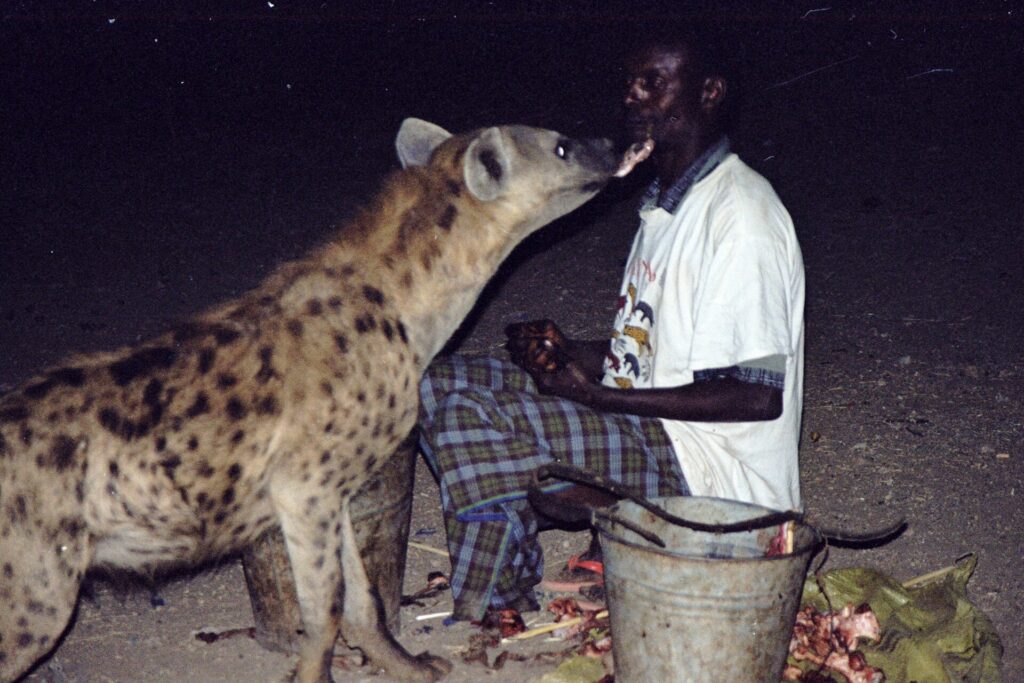
For generations people in Harar have fed the spotted hyenas that come to the edge of the city at night, a tradition said to keep the peace between the town and the animals. Each evening after dark, “hyena men” at the edge of the city call the animals by name and feed them scraps of meat, sometimes from a stick held in their mouths. Visitors can watch and, if they dare, feed a hyena themselves. It is a genuinely wild encounter: stay calm, follow the feeder’s instructions and keep children close.
Coffee and food
The Harar region grows a famous coffee with a fruity, wine-like flavour, and you will smell it roasting everywhere. Harari food has its own dishes, influenced by the trade routes to Arabia and India. For the wider cuisine, see Ethiopian dishes to try first.
Getting there
- By air: fly from Addis Ababa to Dire Dawa (about an hour), then drive about 55 km uphill to Harar. See Dire Dawa.
- By rail and road: the Addis Ababa–Djibouti railway stops at Dire Dawa; the drive from Addis Ababa is about 525 km.
When to go
Harar is at about 1,885 metres, so it is warm by day and pleasant at night for most of the year. The main rains fall from roughly July to September. During Ramadan, life slows in the day and comes alive after sunset, and the end of the fast is a wonderful time to visit.
Tips for visitors
- Dress modestly, especially near mosques and shrines. Women may want a headscarf.
- Non-Muslims should not enter mosques unless invited.
- A local guide is worth having for the first walk through the alleys.
- Carry small notes for guides, house visits and the hyena feeders; see Ethiopian birr notes.
- Many people chew khat in the afternoons. Photographing them without asking causes offence.