Updated October 2026. Park fees, scout and guide rates change; they are not listed here. Confirm them at the park office in Debark.
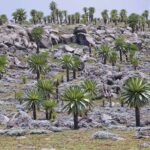
The Simien Mountains are one of the great landscapes of Africa: a high plateau cut off by sheer cliffs that drop more than a thousand metres to the lowlands, with jagged volcanic pinnacles rising out of the valleys below. They are home to the gelada, the “bleeding-heart” monkey that lives nowhere else on earth, the rare walia ibex, and Ras Dejen, Ethiopia’s highest mountain. Whether you come for a day or a ten-day trek, it is unforgettable.
The Simien Mountains are in the Amhara region. Read your government’s current travel advice before planning a visit.
Simien Mountains National Park
The park protects the heart of the range and has been a UNESCO World Heritage Site since 1978, one of the first sites inscribed anywhere in the world. Much of it lies above 3,000 metres. Farming villages, terraced fields and grazing land are part of the landscape, and the park works with these communities, so you will share the trails with shepherds and their animals.
The wildlife
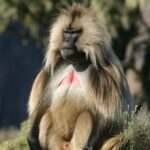
- Gelada. Large troops of these grass-eating monkeys graze along the cliff edges, and they are relaxed enough for you to sit quietly among them. The males’ manes and the red patch on their chests make them unmistakable.
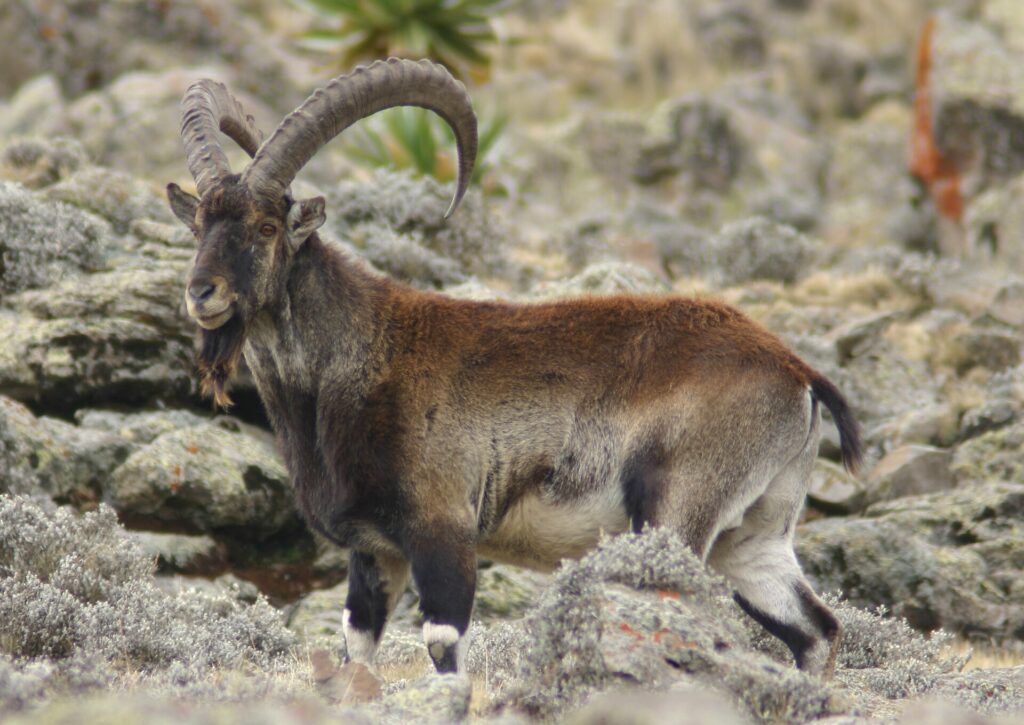
- Walia ibex. A wild goat found only in the Simien Mountains, seen on the steep cliffs around Chenek. Its numbers have recovered from a few hundred in the 1990s.
- Ethiopian wolf. Africa’s rarest carnivore lives here in small numbers, though the Bale Mountains are a better place to see it.
- Birds. Lammergeiers (bearded vultures) ride the updrafts along the escarpment, alongside thick-billed ravens and many highland species.
Trekking routes
Treks start from Debark, the town where the park headquarters is, about 100 km north of Gondar. The classic route follows the escarpment east through a chain of campsites:
- Sankaber (about 3,250 m): first camp, with geladas and big views.
- Geech (about 3,600 m): a village and camp near the viewpoint of Imet Gogo, one of the finest panoramas in the park.
- Chenek (about 3,600 m): the best place for walia ibex, below the peak of Bwahit (about 4,430 m).
- Ras Dejen (about 4,550 m): the summit, reached in two to three more days from Chenek via the Mesheha River valley.
Two or three days is enough to see the geladas, Imet Gogo and Chenek. Allow seven to ten days for Ras Dejen. If time is short, a road now runs through the park, and you can make day trips by car with short walks.
How it works
- You must hire an official scout (a ranger) for any walk in the park, and most people also hire a guide. Both are arranged at the park office in Debark.
- Mules and muleteers can carry your bags and camping kit.
- Accommodation ranges from campsites with basic huts to a small number of lodges near the park boundary.
- Many tour companies in Gondar and Addis Ababa arrange complete treks with permits, food and transport.
When to go
- September to November: the end of the rains; green, full of flowers and less crowded.
- December to March: dry and clear, with the best views, but nights can fall below freezing.
- June to August: the main rains. Trails are muddy and clouds often hide the views.
See when to visit and Ethiopian seasons.
Health and packing
The altitude is serious. Spend a night or two in Gondar or Debark first, climb slowly and turn back if a headache gets worse; health and medical care has more. Pack warm layers, a hat and gloves for the nights, sun protection for the days, good boots, a water filter or purification tablets, and a head torch.