Updated October 2026. Prices for guides, village visits and photographs change and are not listed here; agree them before you start.
The Lower Omo Valley in Ethiopia’s far south-west is one of the most culturally diverse places in Africa. Along the Omo River and the dry plains and hills around it live more than a dozen peoples, including the Hamar, Karo, Mursi, Dassanech, Nyangatom, Ari and Banna, each with its own language, dress, ceremonies and way of life. It is also where some of the oldest fossils of modern humans have been found. A visit can be one of the most memorable parts of a trip to Ethiopia, if it is done with care.
Why the Omo Valley matters
The Lower Valley of the Omo has been a UNESCO World Heritage Site since 1980 for its fossils. Remains found at Kibish, known as Omo I and Omo II, are among the oldest known anatomically modern humans, dated to around 200,000 years ago. Together with Lucy and the Awash fossils, they are part of why Ethiopia calls itself the land of origins.
Today the valley is changing quickly. Roads, schools, mobile phones, irrigation schemes and dams on the river are reshaping life here, and the communities are anything but a museum. Visit with that in mind.
The peoples you may meet
- Hamar. Pastoralists around Turmi and Dimeka, known for the ukuli bull-jumping ceremony that marks a young man’s passage to adulthood. Women wear their hair in ochre-red ringlets.
- Karo. A small community on the banks of the Omo, famous for body painting with chalk and ochre.
- Mursi. Living around Mago National Park, where some women wear large lip plates.
- Dassanech. On the delta near Lake Turkana, the southernmost people of the valley.
- Ari. Farmers in the green hills around Jinka, the largest group in South Omo.
How to visit
- Go with a local guide. Guides from the area know the communities, speak the languages and can tell you when ceremonies and markets take place. Most visitors come on a tour from Addis Ababa or Arba Minch with a driver and a 4×4.
- Bases: Jinka, with an airport and the South Omo Museum and Research Center, and Turmi, the centre of Hamar country, with lodges and campsites.
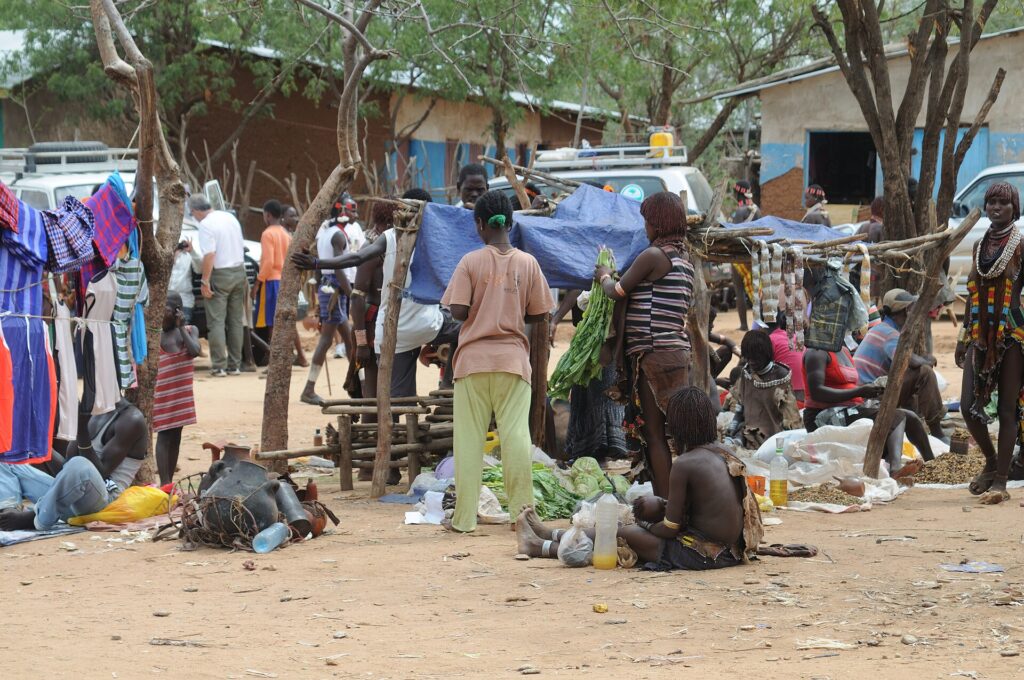
- Markets: weekly markets in towns such as Turmi, Dimeka and Key Afer are the best and most natural way to meet people. Ask your guide which day each one is held.
- Ceremonies: a Hamar bull jumping is a family event. Go only if your guide has been invited, and behave as a guest.
Photography and respect
Photography is the most sensitive part of an Omo visit. In many villages people expect a payment for each photo, which can turn a visit into a transaction for everyone.
- Ask before photographing anyone, and accept a no.
- Agree the fee with your guide before you start; paying through the guide is fairer and calmer.
- Spend time first: buy something at the market, sit, talk through your guide, then ask.
- Avoid handing out sweets, pens or money to children.
- Choose community-run visits and local guides, so that more of what you spend stays in the valley.
Getting there
- By air: fly from Addis Ababa to Jinka, or to Arba Minch and drive on. See Arba Minch and Dorze.
- By road: the drive from Addis Ababa takes two days via Arba Minch or Hawassa; see Hawassa.
When to go
The dry seasons, roughly December to February and June to September, are best. Heavy rain from March to May, and again in October and November, can make dirt roads impassable. The lowlands are hot all year. See when to visit, and ask a travel clinic about malaria before you go; health and medical care has more.
Read your government’s current travel advice for southern Ethiopia before travelling.