Updated October 2026. Prices change often and are not listed here; check current entry fees locally.
Gondar was Ethiopia’s royal capital for more than two centuries, and it still looks the part. In the middle of the modern city stands a walled enclosure of stone castles, towers and banqueting halls built by a line of emperors from the 1630s onwards, so different from anything else in the country that it is often called the “Camelot of Africa”. Add one of the most beautiful church interiors in Ethiopia, and the most famous Timkat celebration of the year, and Gondar earns its place on the classic northern route.
Gondar is in the Amhara region. Read your government’s current travel advice before planning a visit.
A short history
Emperor Fasilides made Gondar his capital in about 1636, ending a long period in which Ethiopian rulers moved their court from camp to camp. His successors added their own palaces beside his, and Gondar remained the seat of the emperors until the mid-19th century. The royal city mixed Ethiopian, Portuguese, Indian and Arab building styles, and the arts flourished, especially church painting. For the wider story, see Ethiopia: a brief history.
What to see
Fasil Ghebbi, the royal enclosure
The heart of Gondar is Fasil Ghebbi, a compound of about 70,000 square metres surrounded by a stone wall with twelve gates. Inside are the castle of Fasilides, with its crenellated towers, and later buildings including the palace of Iyasu I, the library of Yohannes I, the castle of Bakaffa, banqueting halls, stables and a sauna-like steam bath. Fasil Ghebbi has been a UNESCO World Heritage Site since 1979. Allow at least two hours, and take a local guide to bring the buildings to life.
Fasilides’ Bath
About 2 km from the centre is a two-storey pavilion standing in a large rectangular pool, shaded by trees whose roots grip the walls. For most of the year the pool is empty. At Timkat in January it is filled with water, blessed by priests, and crowds jump in. It is one of the great sights of the Ethiopian year.
Debre Berhan Selassie
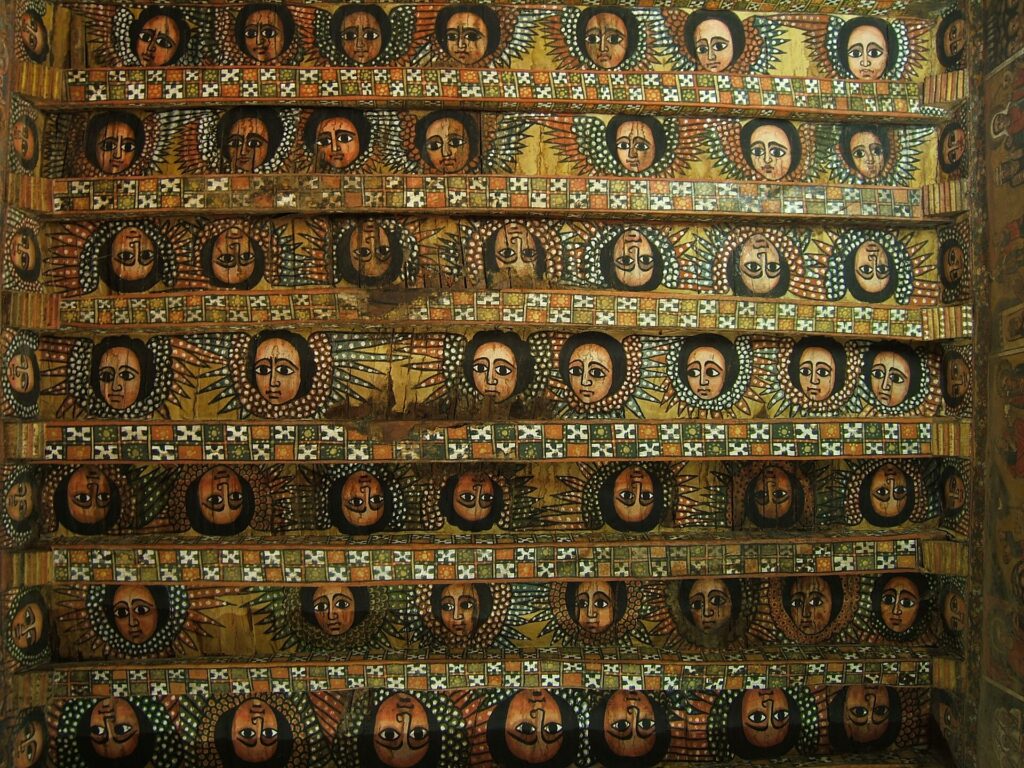
This small church on a hill, surrounded by a stone wall, holds Gondar’s greatest treasure: a ceiling covered in rows of painted winged angels’ faces, each looking down with large dark eyes, and walls painted with scenes from the Bible and the lives of the saints. Most of the paintings date from the late 17th and 18th centuries. Go in the morning, when the light is good, and remove your shoes before you enter.
Kuskuam and the hills
On a hill north-west of the centre are the ruins of Kuskuam, the palace and church built by Empress Mentewab in the 1730s. The views over the city are worth the trip on their own.
Gondar as a base
Gondar is the gateway to the Simien Mountains, whose park headquarters at Debark lies about 100 km to the north. Many travellers spend a night in Gondar before and after a trek. It is also on the road between Bahir Dar and Lake Tana to the south and the north of the country.
Getting there
- By air: daily flights from Addis Ababa take about an hour, and are often combined with Lalibela, Aksum and Bahir Dar on a round trip.
- By road: Gondar is roughly 180 km north of Bahir Dar and around 740 km from Addis Ababa, a long two-day drive.
When to go
October to March is dry and clear. January is the busiest month because of Genna and Timkat; book hotels well ahead. From June to September the rains are heavy, but the countryside is at its greenest. See when to visit.
Tips
- Dress modestly for the churches and carry a scarf.
- Bring small birr notes for church entry, guides and tips; see Ethiopian birr notes.
- Gondar sits at about 2,100 metres, so evenings are cool.