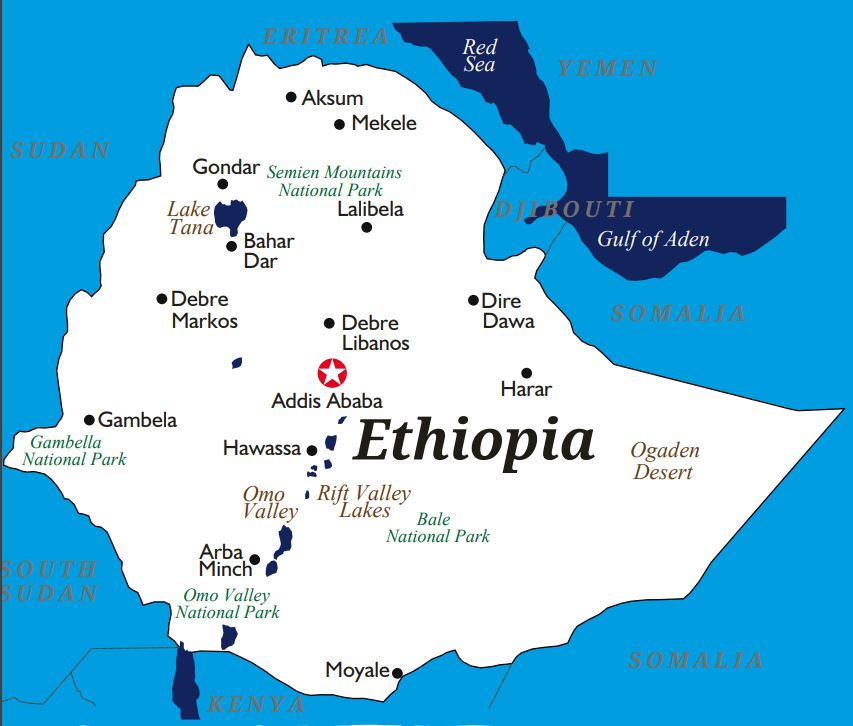
Axum also spelt as Aksum is an ancient city located in the Tigray Region of northern Ethiopia. The city was the original capital of the Kingdom of Aksum and is one of the oldest places in Africa that has continuously been inhabited by humans.
Axum was added to the UNESCO World Heritage Sites in 1980 due to their historic value. The major Aksumite monuments in the town are the trademark Statue. These obelisks are believed to be about 1,700 years old and have over the years become a symbol of the Ethiopian people’s identity.
The largest number of these Statue are to be found in the Northern Statue Park. Their height range varies, but the Great Statue is said to have stood 33-meters high, 3.84 meters wide and had a 2.35 meters foundation with a total weight of 520 tonnes. The Great Statue is believed to have fallen and broken during construction. The Obelisk of Axum, which stands 24.6 meters high, 2.32 meters wide and has a 1.36 meters foundation with a total weight of 170 tonnes, is the famous Obelisk that was removed by the Italian army in 1937 and was on display in the Italian capital city of Rome for many years before it was finally returned to Ethiopia in 2005 and reinstalled July 31, 2008.
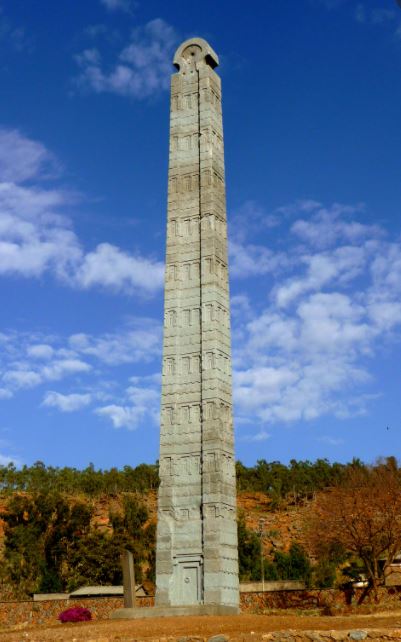
The obelisk was first broken into pieces before being shipped. BIBLICAL ARK OF THE COVENANT Aside from its famed obelisks, the city of Axum boasts another major feature that is the Old and New Cathedrals of St. Mary of Zion. The Old St Mary of Zion Cathedral is said to have been built in 1665 by Emperor Fasilides. It is in this building that most Orthodox Christians and other Christians believed that the original Ark of the Covenant is under lock and key.
The new Cathedral of St. Mary of Zion stands next to the old one. The new cathedral was built to honour a promise made by Emperor Haile Selassie to the Our Lady of Zion for the liberation of Ethiopia from the Fascist occupation. The cathedral is built in a neo-Byzantine style. While women are not allowed in the old cathedral, women are however allowed inside the new cathedral. Sandwiched between the two cathedrals is a small chapel known as The Chapel of the Tablet which was built at the same time as the new cathedral.
This chapel is said to be where the original Ark of the Covenant is currently housed. Emperor Haile Selassie’s consort, Empress Menen is said to have paid for its construction from her private funds. Like in Biblical times when only a select few were allowed anywhere close to the Ark of the Covenant, admittance to the chapel is strictly forbidden to all but the guardian monk who resides in the church. Entrance to the chamber that is believed to house the Ark of the Covenant is even forbidden to the Patriarch of the Orthodox Church. The two cathedrals and the chapel are, quite naturally, the focus of religious pilgrimages and considered the holiest sites in Ethiopia to members of its Christian Orthodox church.
KING SOLOMON AND QUEEN OF SHEBA Ethiopian legend has it that it was from Axum that Makeda, the Queen of Sheba, travelled north-east to Jerusalem to visit King Solomon. It is said that she had a son called Menelik from her short relationship with King Solomon. Menelik is said to have grown up in Ethiopia but traveled to Jerusalem as a young man to visit his father’s homeland. Menelik is believed to have lived in Jerusalem for several years before returning to his country with the Ark of the Covenant. To this day, Ethiopian Orthodox Christians believe that the original Ark of the Covenant that Menelik brought with him from Jerusalem still exists in Axum.
For visiting the site today, see Aksum: stelae, churches and tombs. The wider story is in Ethiopia: a brief history, and Aksum is one of Ethiopia’s UNESCO World Heritage Sites.