Lalibela is the reason many people come to Ethiopia. Eleven medieval churches stand here, carved downwards into solid volcanic rock: not built, but excavated. They are still in daily use by priests and congregations about eight hundred years later. Lalibela is a UNESCO World Heritage Site, one of the first two in Ethiopia, inscribed in 1978 together with the Simien Mountains.
What surprises visitors is not only the scale. It is that this is a working place of worship, not a museum. A priest may unlock a door for you, and in the next chamber someone will be praying.
What Lalibela is
In the twelfth and thirteenth centuries, under King Gebre Mesqel Lalibela of the Zagwe dynasty, a group of churches was cut into the red volcanic rock of the highlands at about 2,500 metres above sea level.
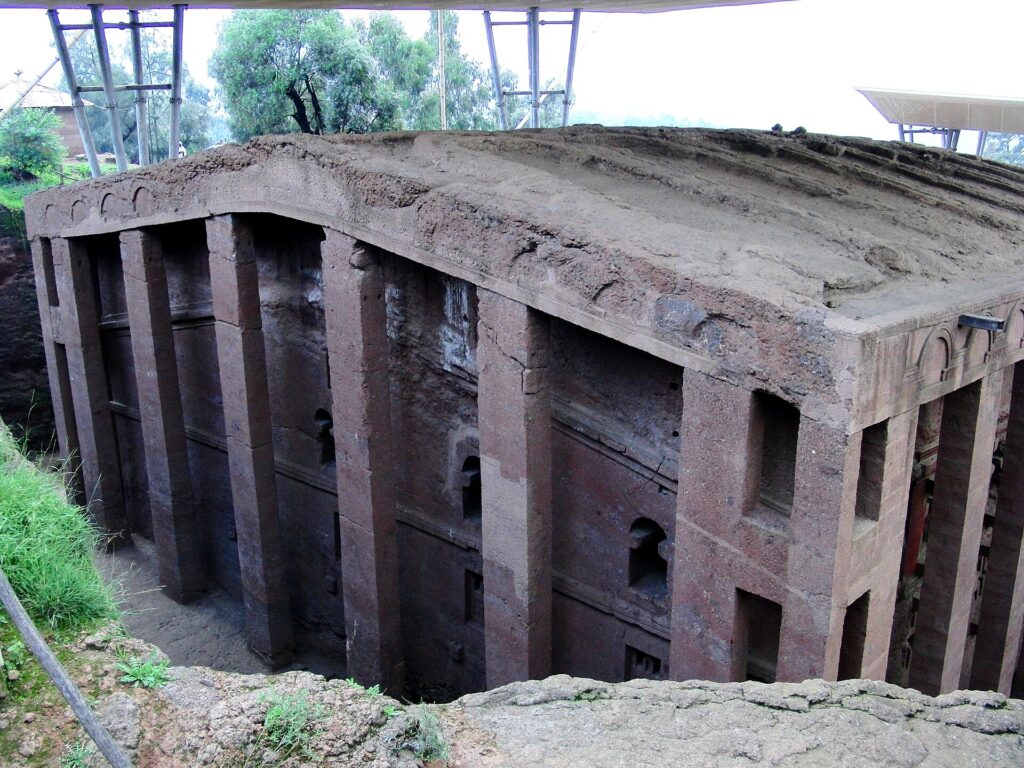
The technique is the remarkable part. The masons began at ground level and cut downwards: first a trench to isolate a block of rock, then the hollowing of that block from the top to make the interior. Doors, windows, columns, arches and reliefs were all carved out of the single piece of stone. There are no joints because there are no blocks. Nothing was added, and everything was removed.
Tradition holds that the work took 24 years and that angels worked through the night. Archaeologists suggest a longer period and several phases of construction, and some of the churches may reuse earlier structures.
The intention, according to tradition, was a “New Jerusalem”. Pilgrimage to the real Jerusalem had become difficult after the city fell to Saladin in 1187. The stream that runs between the churches is called the Jordan, and several sites carry the names of places in the Holy Land.
The churches
The eleven churches fall into three groups. Their names begin with Bete, which means “house of”.
The northern group
- Bete Medhane Alem (House of the Saviour of the World) is believed to be the largest monolithic rock-hewn church in the world, about 33 metres long and surrounded by a colonnade of square pillars.
- Bete Maryam (House of Mary) is often said to be the oldest of the churches and is much loved by the congregation. It has frescoes and carved capitals, and a pillar that is wrapped in cloth, which tradition says records the past and the future.
- Bete Golgotha and Bete Mikael are joined together. Bete Golgotha has life-size reliefs of saints, and women are not permitted inside. A closed chapel next to it, the Selassie Chapel, is the reputed tomb of King Lalibela.
- Bete Denagel (House of the Virgins) is a smaller church of the group.
The eastern group
- Bete Amanuel has some of the finest stonework in Lalibela, with an exterior cut to imitate the layered walls of Aksumite buildings.
- Bete Merkorios, Bete Abba Libanos and Bete Gabriel-Rufael are connected by trenches and tunnels. One long tunnel is pitch dark and is walked through without a light, and it is traditionally said to represent the path through hell to heaven.
Bete Giyorgis
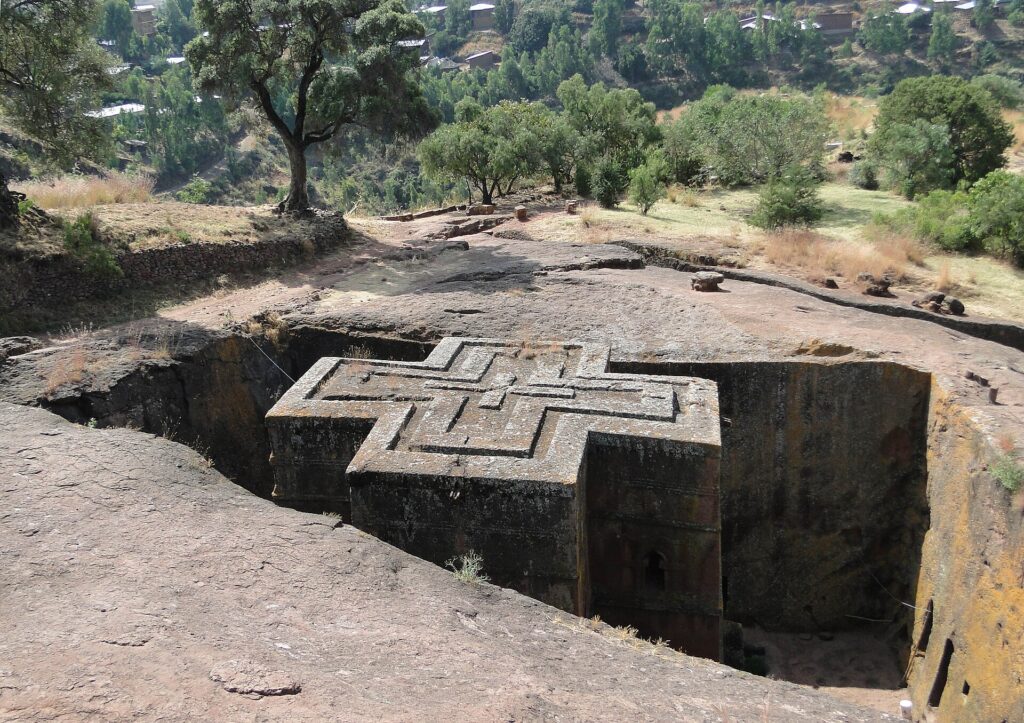
Bete Giyorgis, the church of St George, stands on its own, apart from the other two groups. It is the image everybody knows: a perfect Greek cross, about 15 metres deep, sunk in a pit of its own with no other structure touching it. Tradition says it was built last, after St George appeared to the king to complain that no church had been dedicated to him. Seen from the rim above, it is one of the great sights of Africa. Go at the end of the day, when the light is low.
Visiting: the practical part
- The ticket. One entry ticket covers all the churches and is bought at the main ticket office. The price, how many days it is valid and the way you pay are set by the authorities and change from time to time, so check the current terms at the office. Keep the ticket, since you will be asked for it at each group.
- Guides. A licensed guide is close to essential. Without one, you will walk past most of what matters: the meaning of the reliefs, which chamber holds what and when a service is about to begin. Agree the rate and what it includes before you start, and tip for good service.
- Shoes off. Shoes come off in every church. A “shoe keeper” will watch them for a small tip. Wear socks, because the stone is cold and rough.
- Dress modestly. Cover your shoulders and knees. Women should bring a scarf for their heads.
- Allow two days. One rushed day is possible. Two days let you see the northern group in the morning light and Bete Giyorgis in the evening, with time for the monasteries outside town.
- It is physical. There are steep steps, uneven rock, narrow trenches and dark tunnels, all at 2,500 metres. Wear sturdy shoes. If you find stairs or tight spaces difficult, tell your guide, because some parts can be skipped and there are viewpoints that avoid the worst of it.
- Photography is allowed in most churches, without flash, and interiors are very dark. Ask before you photograph priests, and ask before you photograph a service.
Getting there
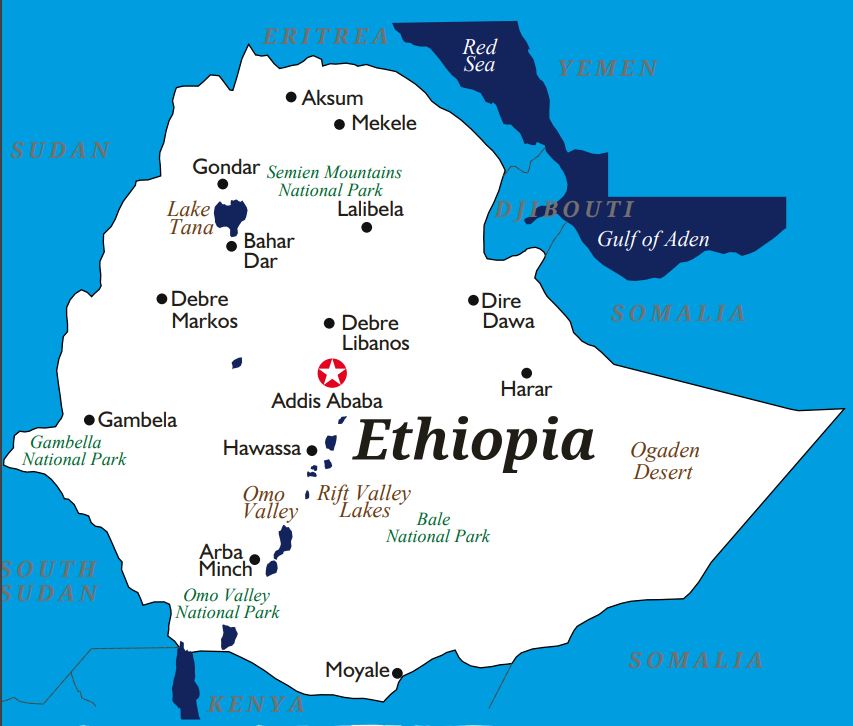
By air. Ethiopian Airlines flies from Addis Ababa to Lalibela, a flight of about an hour, and it is the simple way to get there. Schedules and conditions in the north can change, so check the current timetable and your government’s travel advice before you book. Hotels arrange pickups from the airport, which is some distance from the town.
By road. The journey from Addis Ababa takes two long days on mountain roads, usually through Woldia. It is spectacular and tiring. Do not travel these roads at night, and read your government’s current travel advice before you plan any road trip in the north, because conditions in the region change.
For other ways of getting around, see your first two hours at Bole airport and things to do in Addis Ababa.
When to go
The dry season, from about October to March, has the best weather: clear, cool days and cold nights. The rains fall from about July to September, when the hills are green and dramatic, there are few tourists, and walking can be slippery. See when to visit.
Two dates transform the town.
Genna, Ethiopian Christmas, 7 January. Large crowds of white-robed pilgrims arrive in Lalibela, and many walk for days to get there. The all-night service, with chanting, drums and prayer sticks, is among the most remarkable religious events anywhere. Book accommodation months ahead, and expect the town to be full. See Genna.
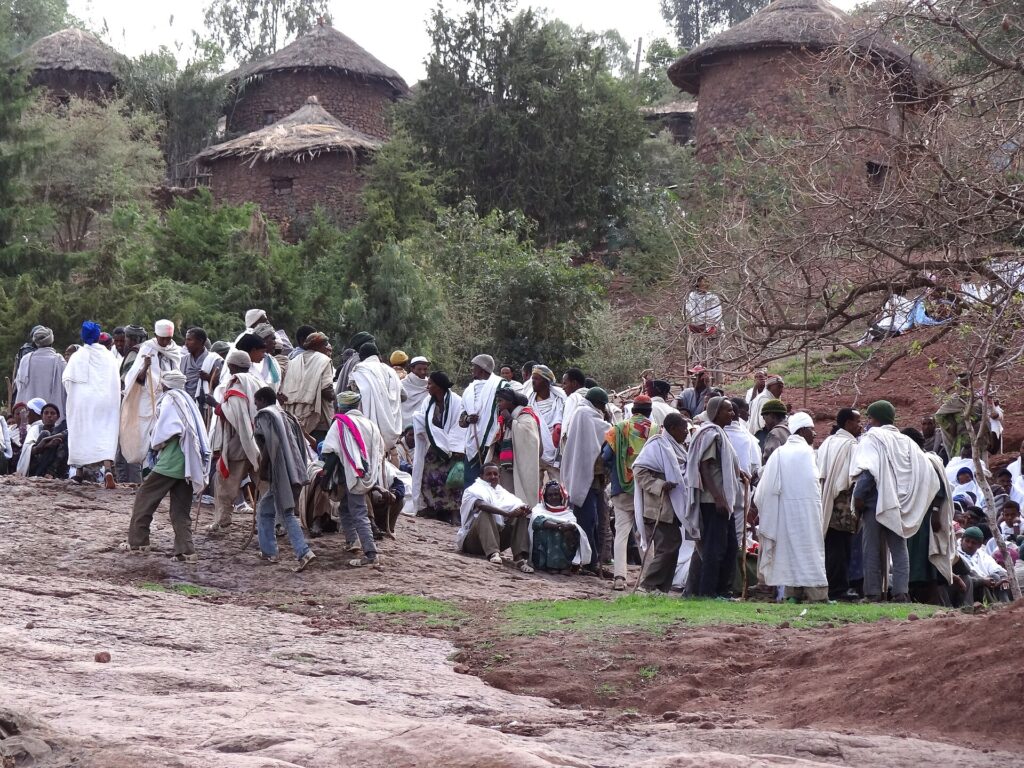
Timkat, 19 January. The feast of Epiphany is spectacular in Lalibela too, though Gondar is the more famous setting. See Timkat.
Beyond the eleven churches
- Asheton Maryam is a monastery high on a mountain above the town, reached by a steep walk or on a mule. The church is modest, and the view over the surrounding highlands is the reward.
- Yemrehanna Kristos lies outside the town, roughly 40 kilometres by road. It is a church built of alternating layers of wood and stone in the Aksumite manner, inside a cave, and it is older than the rock-hewn churches. Many visitors find it one of the most atmospheric places they see in Ethiopia.
- Nakuto La’ab is a small cave church a short drive from town, named after a later king of the dynasty.
- The weekly market draws people from villages across the region, and it is a good way to see local life.
Staying and eating
Lalibela has a range of places to stay, from simple guesthouses for pilgrims to lodges on the escarpment with long views over the mountains. The sunset from the ridge is worth a small extra payment. Book ahead in the high season and far ahead for Genna.
Eating is simple and good: injera with shiro, tibs and doro wat, with tej honey wine. See Ethiopian dishes to try first and Tej and Tella. Cash is the norm. ATMs exist but should not be relied on, so bring enough birr. See using foreign cards and ATMs.
A word about the tourism
Visitor numbers to Lalibela fell sharply after 2020, and the town, which depends heavily on tourism, was hit hard. Guides, hotel staff and shopkeepers are still recovering. If you visit, hire a guide, tip properly, buy locally and pay a fair price without hard bargaining. It matters more here than in most places.
Frequently asked questions
Why is Lalibela famous?
For eleven medieval churches carved downwards into solid rock in the 12th and 13th centuries, still in daily use, and a UNESCO World Heritage Site since 1978.
How many rock-hewn churches are there in Lalibela?
Eleven, in three groups: the northern group, the eastern group and Bete Giyorgis standing alone.
How much does it cost to visit Lalibela?
There is an entry ticket for all the churches and a fee for a guide. Prices change, so confirm the current ones at the ticket office.
How do I get to Lalibela?
Fly from Addis Ababa, about an hour. By road it takes two long days.
How many days do I need in Lalibela?
Two is right: one for the northern and eastern groups, and one for Bete Giyorgis and the monasteries outside town.
Can women enter all the churches?
Almost all. Women cannot enter Bete Golgotha, and women should cover their heads inside churches.
Is Lalibela worth visiting?
It is one of the most remarkable places in Ethiopia and among the most extraordinary religious sites anywhere.
About the author: Dawit Deggu Mohis
Dawit Deggu Mohis is an Ethiopian travel enthusiast who has spent years exploring and learning about his country’s rich history, diverse cultures, and stunning landscapes. Through his writing he shares practical tips, cultural insights, and personal discoveries to help travellers experience Ethiopia more deeply and respectfully. Found something on this page that has changed? Tell him and it will be fixed.
Last checked: 25 October 2026. Facts on the churches are drawn from UNESCO and standard references; fees, schedules and conditions should be confirmed before you travel.